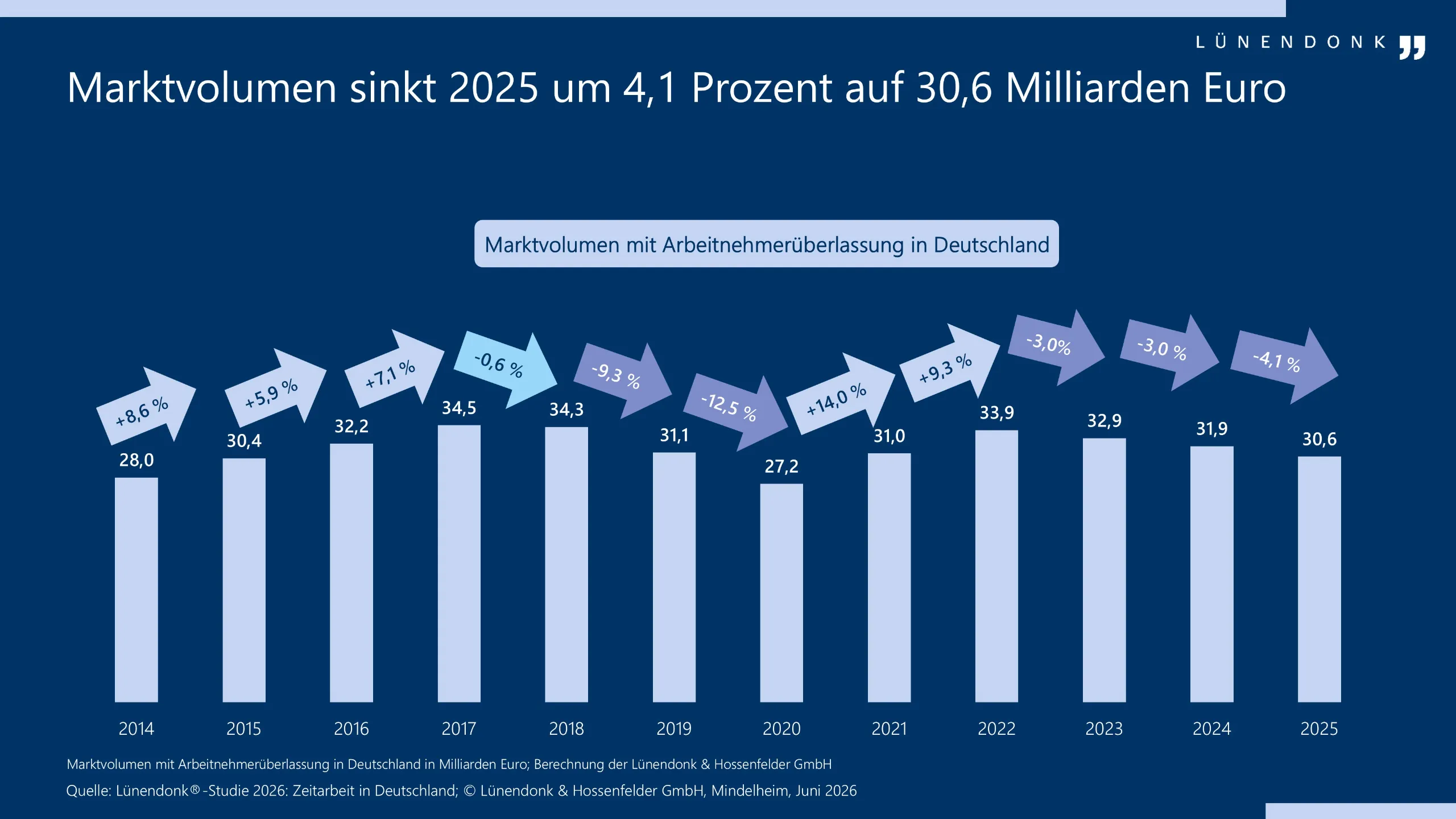
- Market volume declined for the third consecutive year in 2025 to 30.6 billion euros
- Weak economy, price pressure, and declining candidate quality continue to burden the industry
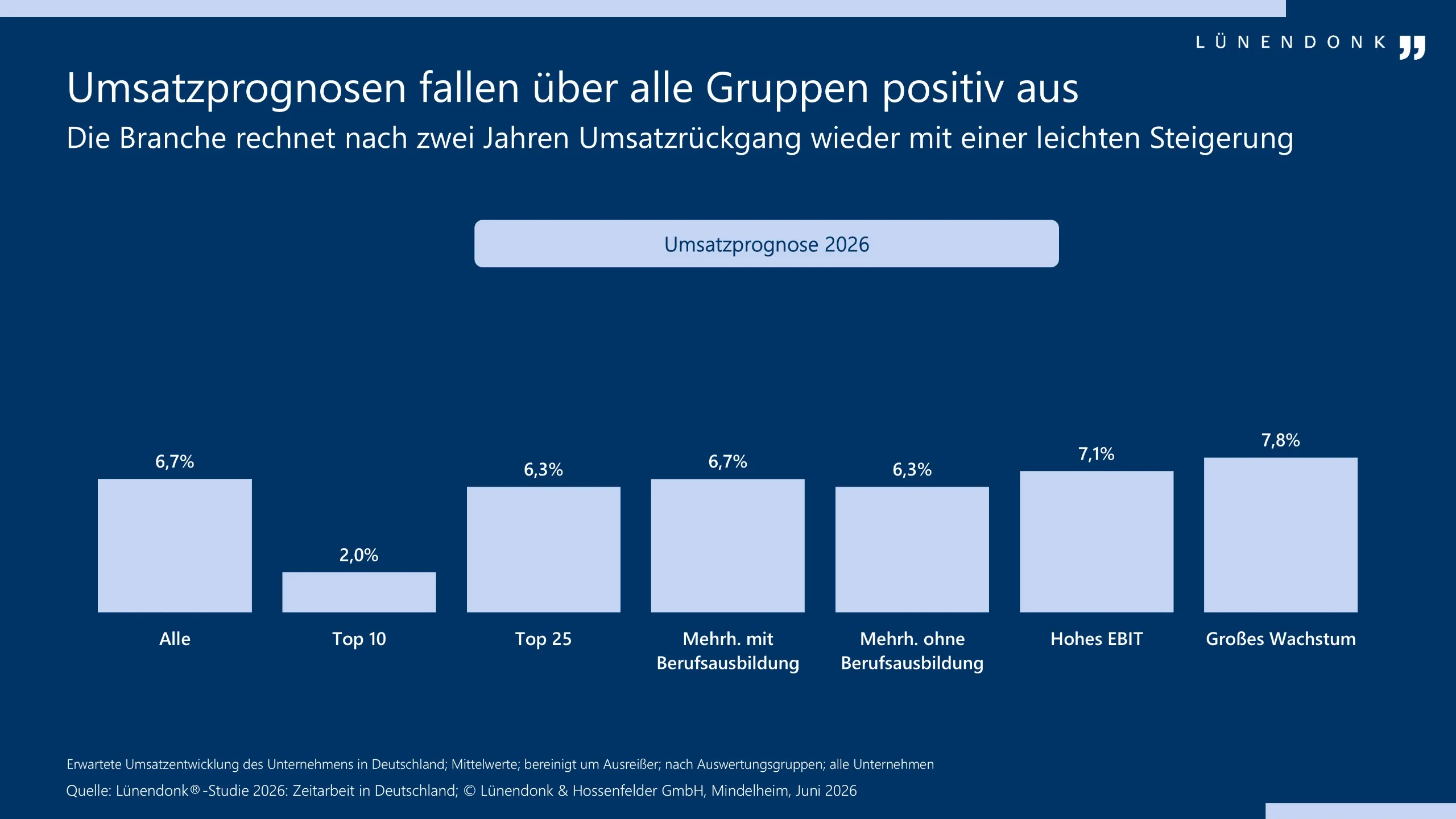
- Service providers nevertheless expect average revenue growth of 6.7 percent for 2026
- New Lünendonk Survey now available
Mindelheim, June 24, 2026 — The German temporary staffing market remains under pressure. For the third consecutive year, the market volume for temporary employment in Germany has declined: In 2025, it stood at 30.6 billion euros according to calculations by Lünendonk & Hossenfelder – down from 31.9 billion euros in the previous year. The tense market situation is also clearly evident at the company level: 67 percent of the surveyed staffing service providers recorded declining revenues in fiscal year 2025, which fell by an average of 6.5 percent. Nevertheless, the industry is cautiously optimistic about the current fiscal year: For 2026, the surveyed companies expect average growth of 6.7 percent again. These are the findings of the new Lünendonk Survey 2026 “Temporary Staffing in Germany.” The Survey is available at www.luenendonk.de.
Cautious Optimism Despite Difficult Framework Conditions
The temporary staffing industry remains significantly burdened by the difficult economic environment. As the greatest obstacle to success, 77 percent of the surveyed companies cite the persistent economic weakness. This is followed by price pressure at 36 percent and declining candidate quality at 33 percent. Rising costs, bureaucracy, and the external shortage of skilled workers also complicate business development. Nevertheless, staffing service providers expect average revenue growth of 6.7 percent again for 2026, and even 7.9 percent for 2027. While the Survey participants expect declining demand in the automotive industry and mechanical engineering, they anticipate new growth impulses from areas such as defense, aerospace, and pharmaceuticals and life sciences.
“The industry remains under pressure, but the outlook is brightening,” says Survey author and Lünendonk Managing Director Jörg Hossenfelder. “Temporary staffing remains an important tool for companies to respond flexibly to changes in demand. The decisive factor will be which providers specialize more strongly, expand digital processes, and consistently develop new growth areas.”
AI Becomes an Efficiency Driver
Artificial intelligence has gained significantly in importance in the temporary staffing industry. According to the Survey, 63 percent of the surveyed companies already use AI regularly. Another 35 percent are experimenting with AI applications and gaining initial experience, with no company fundamentally ruling out the future use of AI. 76 percent of AI-using companies deploy corresponding solutions in recruiting and candidate management. Other areas of application include administration, text creation and communication, as well as sales and marketing. “AI is no longer a future topic in temporary staffing, but has arrived in the operational day-to-day of many companies,” says Hossenfelder. “Especially given high process volumes, scarce resources, and growing demands for speed and quality, AI can be an important efficiency lever.”
Reference
The new Lünendonk Survey 2026 “Temporary Staffing in Germany” is now available at www.luenendonk.de. The detailed market analysis is based on data from 85 staffing service providers with a cumulative domestic revenue of 12.6 billion euros, as well as numerous background discussions and continuous market observation. The Survey participants represent more than 40 percent of the market volume for temporary employment in Germany.
Downloads