- Only a third use GenAI to manage the customer journey
- 79 per cent plan to increase their spending on digital experience
- Market overview ranks leading DXS providers according to their market positioning
- New Lünendonk Survey 2026 now available
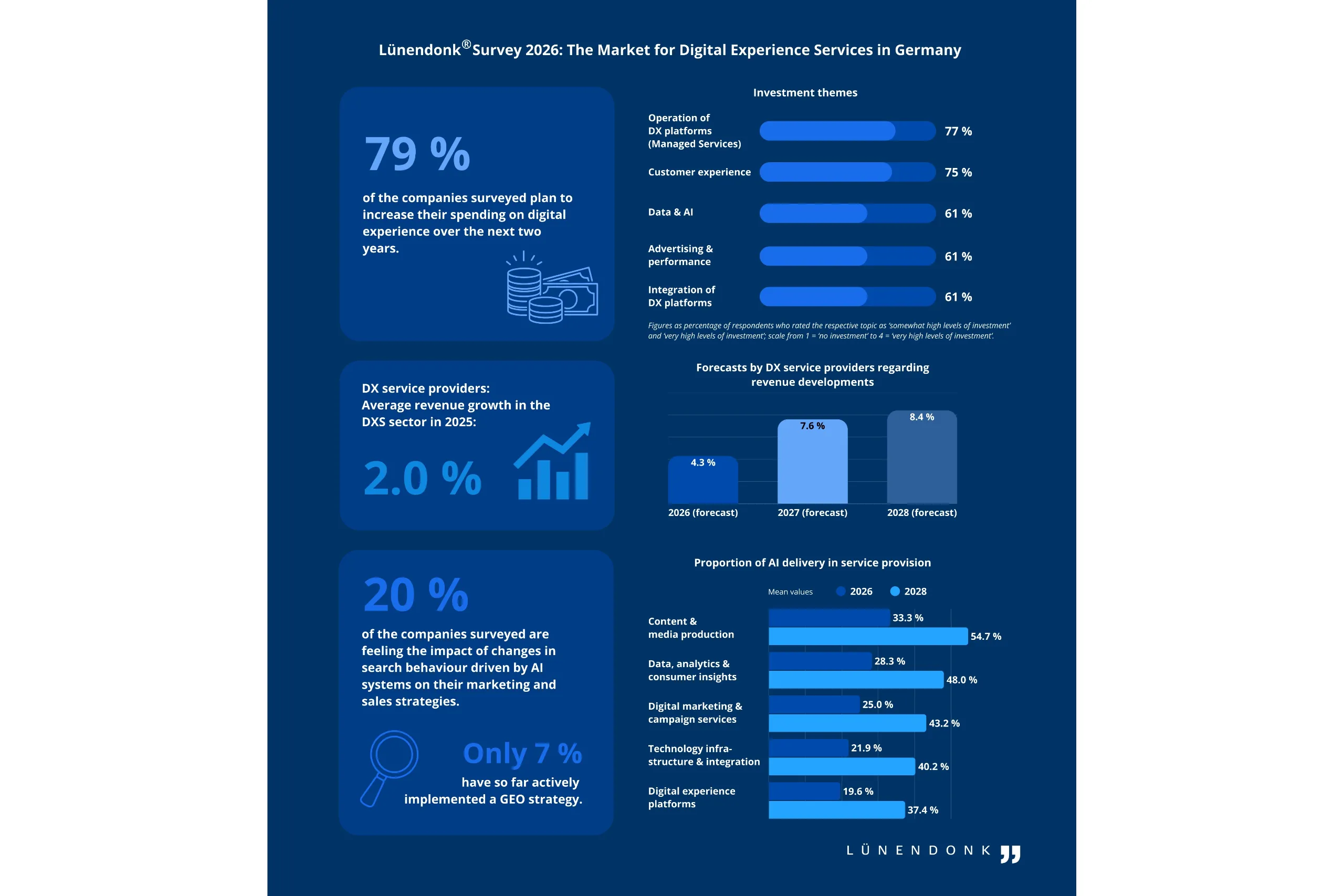
Mindelheim, 5 November 2026 — Artificial intelligence is fundamentally changing the way customers search for information, evaluate offers and make purchasing decisions. Traditional search engines are becoming less important, and in future, businesses will need to design their communications, campaigns and e-commerce in such a way that content is understandable, discoverable and reliable for both people and AI systems. However, implementation is often held back: whilst 79 per cent of companies want to increase their investment in digital experience, there is often a lack of data literacy, comprehensive data integration and end-to-end processes needed to derive value from AI applications.
These are the key findings of the new 2026 Lünendonk Survey, ‘The Market for Digital Experience Services in Germany – From Silos to Integrated Customer Journey Management’, which is now available free of charge at www.luenendonk.de/en. In addition to the latest market and technological developments, the survey profiles the leading providers of Digital Experience Services (DXS) in Germany. The study was produced in technical collaboration with Conclusion, Plan.Net Group, Reply and Valtech.
AI in the customer journey: high expectations, low uptake
Companies have high expectations of AI: 68 per cent hope it will enable a more proactive approach to customers, and 57 per cent expect personalised content. In practice, however, only a third of those surveyed use generative AI to manage the entire customer journey. Initial applications can be found in customer service and content creation. The main factors preventing widespread adoption are an inadequate data infrastructure (69 %), a lack of in-house AI expertise (60 %) and concerns regarding AI governance and compliance (56 %).
“The customer journey is increasingly supported by data and algorithms. However, cross-functional management is not yet established in many companies. AI can accelerate this development if companies consistently continue to develop their AI maturity,” says the survey’s author, Mario Zillmann.
GEO strategies as the key to visibility in AI response systems
AI-powered response systems are fundamentally transforming the digital customer journey. Content must therefore be presented in a way that is both understandable and trustworthy, not only for traditional search engines but also for AI systems and agents. Traditional search engine optimisation is no longer sufficient for this: without a GEO strategy, companies risk becoming invisible in AI-based response systems and losing direct access to customers. Although 55 per cent of companies are already noticing changes in search behaviour, only 7 per cent have an active strategy for Generative Engine Optimisation (GEO). 57 per cent of those surveyed have not yet addressed the issue at all.
The Market for Digital Experience Services
To complement the Lünendonk Survey, Lünendonk is once again publishing a market overview of the leading providers of digital experience services this year. It compares their portfolio focuses, market shares and market positioning. The group of market leaders comprises Accenture, adesso, Capgemini, Conclusion, Deloitte, Plan.Net Group, Reply and Valtech. The group of close followers includes Digitas, IBM, init, msg, PwC, Syzygy and valantic, whilst Diconium, Exxeta, Infosys, team neusta and Telekom MMS are regarded as challengers.
The DXS service providers surveyed increased their revenue from Digital Experience Services by an average of 2.0 per cent in 2025, up from 0.5 per cent in the previous year. This positive sentiment is also reflected in customers’ planned expenditure: 79 per cent of user organisations plan to increase their investment in digital experience over the next two years, with 21 per cent planning to increase it by more than 10 per cent. The driving force behind this is the shift towards integrated, AI-supported management of the customer journey, which requires new operating models in marketing, sales and customer service. The key areas of investment are customer experience (75 %), data & AI, advertising & performance, and the integration of digital experience platforms with back-end systems (61 % each).
About the Lünendonk Survey
For the 2026 Lünendonk Survey, ‘The Market for Digital Experience Services in Germany’, 23 leading DXS service providers and 140 client organisations from Germany, Austria and Switzerland were surveyed about their strategies and key investment priorities.
Downloads